
Measures how well a model predicts groups of data it was not fitted
to, such as sites or species. Each fold of groups is held out in
turn and scored by its expected log predictive density (ELPD).
Higher is better. A fold that importance sampling approximates well takes the
PSIS estimate of loo::loo() on the fold's summed log likelihood.
The rest are refitted without the fold, as lfo_cv.mvgam() refits
the time blocks it cannot approximate. Three settings cover the
range:
pareto_k_threshold = Infrefits nothing. Pareto-k warnings mark folds the approximation fits poorly.The default refits the folds whose Pareto-k exceeds
pareto_k_threshold, which is often a handful.exact = TRUErefits every fold, asbrms::kfold()does.
group takes several columns, such as c("site", "season"). Every
row of one combination stays in the same fold.
Usage
# S3 method for class 'mvgam'
kfold(
  x,
  K = NULL,
  group = NULL,
  folds = NULL,
  exact = FALSE,
  pareto_k_threshold = NULL,
  fold_split = c("grouped", "stratified", "random"),
  seed = NULL,
  silent = 1L,
  ...
)

# S3 method for class 'mvgam_kfold'
print(x, digits = 2L, ...)

# S3 method for class 'mvgam_kfold'
summary(object, ...)

# S3 method for class 'mvgam_kfold'
plot(x, ...)
Arguments
- x
A fitted
mvgamobject, or for the methods anmvgam_kfoldobject.- K
Integer number of folds. With
groupandK = NULL(the default), each group is a fold. AKbelow the number of groups bins the groups intoKfolds withloo::kfold_split_grouped(). Withoutgroup,Kdefaults to 10.- group
Optional character vector of training-data columns whose combinations define the groups.
NULL(the default) takes the closure unit of anocc()ornmix()model and the row otherwise.- folds
Optional integer vector of one fold per training row, replacing
Kandfold_split. Each fold is then held out and scored as one group. A fold never splits a group, which is a closure unit by default.- exact
Logical.
TRUErefits every fold. Defaults toFALSE.- pareto_k_threshold
Numeric. A fold whose Pareto-k exceeds it is refitted.
NULL(the default) takesmin(1 - 1 / log10(S), 0.7)forSposterior draws.Infrefits nothing.- fold_split
"grouped"(the default),"stratified"or"random": theloo::kfold_split_*()function binning groups intoKfolds when there are more groups than folds.- seed
Optional integer seed for the fold split and the refits. The session's random state is restored when the call returns.
- silent
Integer in
\{0, 1, 2\}.0prints each refit and its sampler start and finish lines.1(default) prints the refit count.2prints nothing.- ...
Unused. Anything passed here is refused.
- digits
Integer number of decimal places. Defaults to 2.
- object
An
mvgam_kfoldobject.
Value
A c("mvgam_kfold", "kfold", "loo") object, which
loo::loo_compare() takes as it takes loo.mvgam() results. It
holds:
estimates:elpd_kfold,p_kfoldandkfoldicwith their standard errors.pointwise: the ELPD of each group.pointwise_psisholds the PSIS estimates before any refit.pareto_k: the Pareto-k of each group's PSIS estimate, allNAunderexact = TRUE.n_refitsandrefit_groups: the number of refitted folds and the groups they hold.Kandexact: the number of folds and the mode.group: the grouping columns,"fold"whenfoldswas given, orNULLfor single rows.pareto_k_threshold: the threshold applied, withpareto_k_threshold_adaptiveTRUEwhen the default rule set it.
print() shows the ELPD with its standard error, the folds and
refits and the Pareto k of the PSIS estimates. It then names the
groups with the lowest ELPD and the refitted groups whose ELPD moved
most from the PSIS estimate. summary() returns a tibble with one
row per held-out group: group, its elpd and elpd_share of the
total, for a refitted group elpd_psis and the lift of the refit
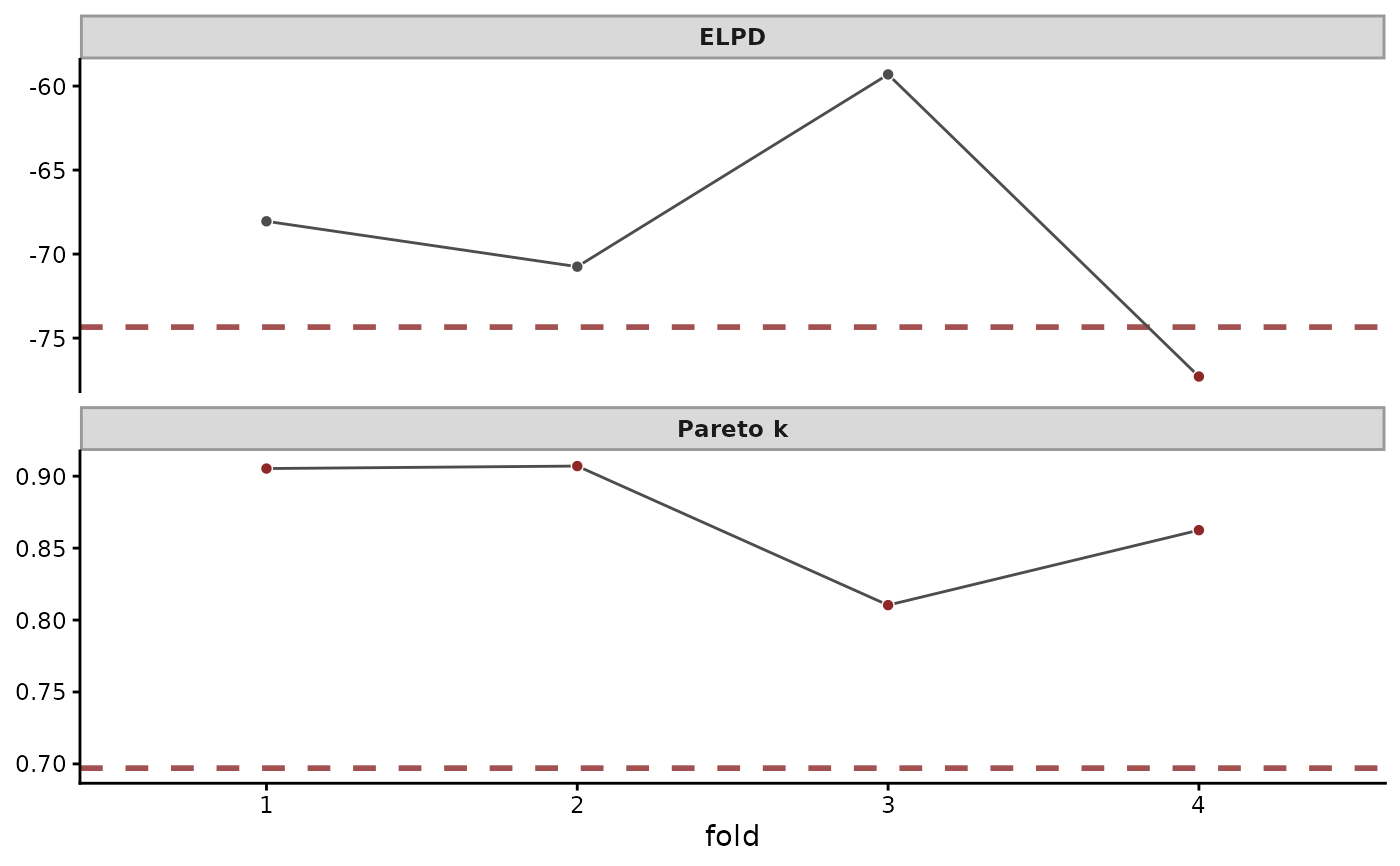
over it, pareto_k and refit. plot() draws the ELPD of each
group and its Pareto k, as plot.mvgam_lfo() does for time blocks.
Dark red points mark a Pareto k above the dashed threshold, where
PSIS is unreliable. In the ELPD panel they mark the groups below the
15% quantile.
References
Burkner, P.-C., Gabry, J. and Vehtari, A. (2020). Approximate leave-future-out cross-validation for Bayesian time series models. Journal of Statistical Computation and Simulation, 90(14):2499-2523. doi:10.1080/00949655.2020.1783262
Vehtari, A., Gelman, A. and Gabry, J. (2017). Practical Bayesian model evaluation using leave-one-out cross-validation and WAIC. Statistics and Computing, 27:1413-1432. doi:10.1007/s11222-016-9696-4
See also
loo.mvgam() approximates leave-one-out cross-validation.
lfo_cv.mvgam() scores forecasts from rolling origins.
summary.mvgam_kfold() and plot.mvgam_kfold() report each group.
The
forecast evaluation article
compares models by cross-validation.
Other model comparison:
bridge_sampler.mvgam(),
compare_elpds(),
lfo_cv.mvgam(),
log_lik.mvgam(),
loo.mvgam(),
loo_compare.mvgam_lfo(),
mvgam_loo_extras,
posterior_average.mvgam(),
waic.mvgam()
Examples
# \dontrun{
# Overdispersed counts: a negative binomial size of 2
set.seed(13)
simdat <- sim_mvgam(family = negbinomial(), n_series = 1L,
n_timepoints = 120L, type = 6L,
family_pars = list(size = 2))
mod <- mvgam(y ~ s(season, bs = "cc", k = 6),
trend_formula = ~ CAR(),
data = simdat$data_train,
family = negbinomial(),
chains = 2, seed = 1, silent = 2)
#> Warning: 5 of 2000 (0.0%) transitions ended with a divergence.
#> See https://mc-stan.org/misc/warnings for details.
# Neighbouring times share information through the trend. Folds of
# contiguous time blocks hold each block out whole. Folds that PSIS
# approximates poorly are refitted.
blocks <- cut(simdat$data_train$time, breaks = 4L, labels = FALSE)
k <- kfold(mod, folds = blocks)
#> kfold: refitting 4 fold(s) ...
#> Warning: 17 of 2000 (1.0%) transitions ended with a divergence.
#> See https://mc-stan.org/misc/warnings for details.
#> Warning: 10 of 2000 (0.0%) transitions ended with a divergence.
#> See https://mc-stan.org/misc/warnings for details.
#> Warning: 2 of 2000 (0.0%) transitions ended with a divergence.
#> See https://mc-stan.org/misc/warnings for details.
#> Warning: 1 of 2 chains had an E-BFMI less than 0.3.
#> See https://mc-stan.org/misc/warnings for details.
#> Warning: 6 of 2000 (0.0%) transitions ended with a divergence.
#> See https://mc-stan.org/misc/warnings for details.
k
#> mvgam k-fold cross-validation
#> elpd_kfold : -275.39 (SE 14.90)
#> kfoldic : 550.78 (SE 29.80)
#> groups : 4 (fold)
#> refits : 4 of 4 folds
#> Pareto k : max 0.91, median 0.88, threshold 0.70 (adaptive)
#>
#> Lowest ELPD (share of the total):
#> 4 -77.29 (28.1%)
#> 2 -70.75 (25.7%)
#> 1 -68.05 (24.7%)
#>
#> Largest change from PSIS to refit:
#> 4 -75.42 -> -77.29
#> 2 -69.58 -> -70.75
#> 1 -67.11 -> -68.05
# The ELPD and Pareto k of each block
plot(k)
 # Next, lfo_cv() scores forecasts made from rolling origins
# }