
Compare posterior loadings between two latent-factor fits
Source:R/compare_loadings.R
compare_loadings.RdSide-by-side comparison of the posterior-median species loadings
from two latent-factor mvgam / jsdgam fits on the same set of
species. Two fits need not order or orient their factors alike,
and a direct overlay of their loadings would mislead.
compare_loadings() applies the orthogonal Procrustes solution
(Schoenemann 1966) that rotates the posterior-median loadings of
fit_b to best match those of fit_a in the least-squares
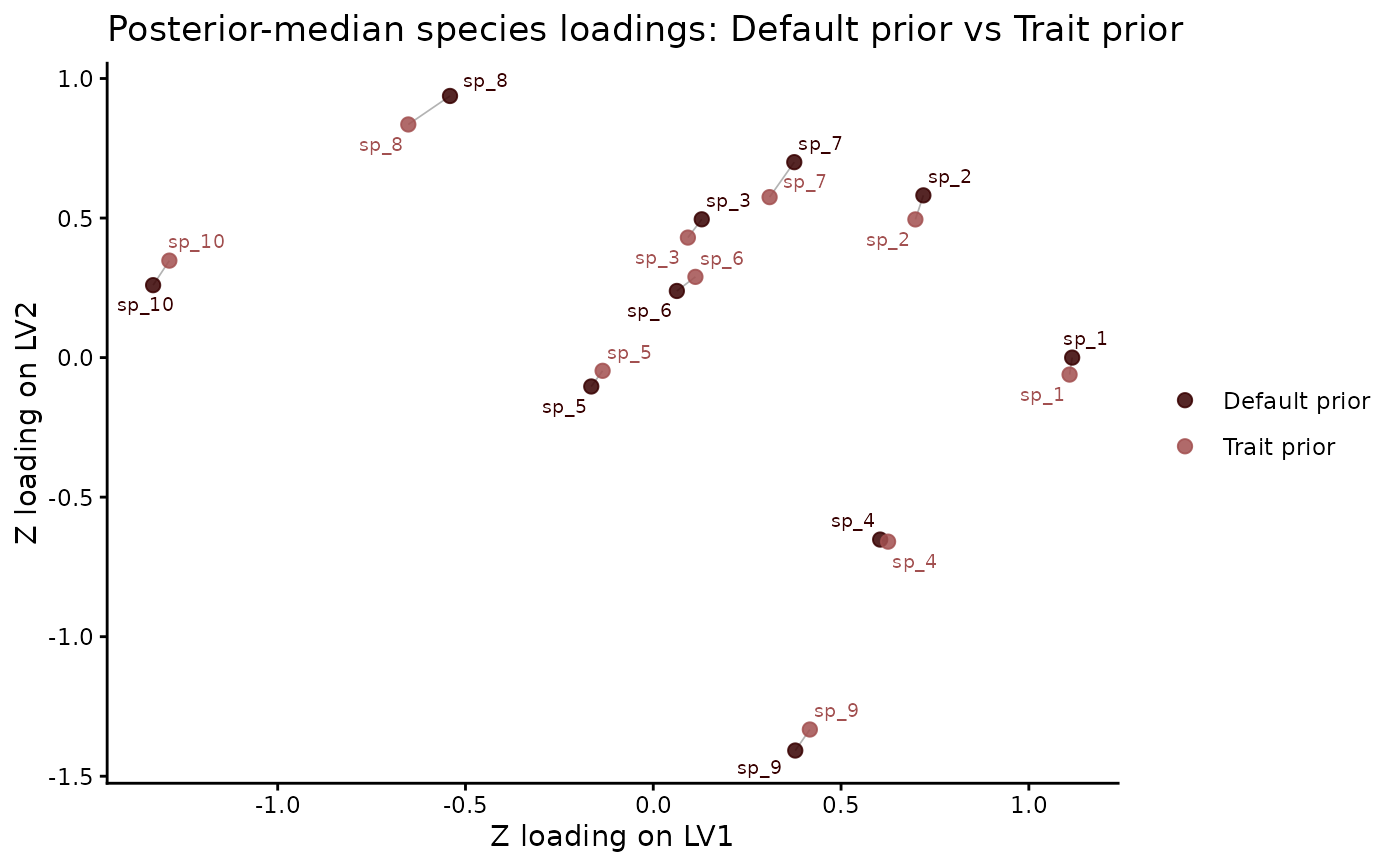
sense, then either overlays both
onto a single biplot with displacement segments (default) or
splits them into two facets sharing axes.
Useful when teaching the effect of a structured loadings prior:
fit one model with loadings_prior = NULL and a second with
traits = or phylo =, then plot the comparison to show how
the trait or phylogeny similarity reshapes the latent positions.
Procrustes alignment is orthogonal: it rotates and reflects the
loadings with their scale unchanged. A factor the model has shrunk
towards zero has short loadings, close to the origin. The panel
shows which species cluster together and how that arrangement moves
between fits. active_factors() reports how many factors the data
support.
Arguments
- fit_a, fit_b
Two fitted
mvgam/jsdgamobjects, each withn_lv >= 2and the same species set in the same factor order.- labels
Optional length-2 character vector of fit labels shown in the legend / facet strips. Defaults to
c("fit_a", "fit_b").- which_lvs
Integer vector of length 2 indicating which two latent factors to plot. Defaults to
c(1, 2).- align
Logical. When
TRUE(default) the posterior-median loadings offit_bare rotated onto those offit_aby orthogonal Procrustes before plotting.FALSEplots each fit with the factors it reports.- facet
Logical. When
FALSE(default) both fits are overlaid on the same axes in different colours, with segments connecting the same species across fits. WhenTRUE, fits are drawn as side-by-side facets on shared axes.- label_species
Character. Controls which species are labelled.
"all"(default) labels every species;"shift"labels the top 10 species by post-alignment displacement between fits;"none"draws unlabelled points only.- ...
Unused. Anything passed here is refused.
Details
The orthogonal Procrustes rotation is the closed-form solution
$$R = U V^T$$ where \(U \Sigma V^T = SVD(Z_a^T Z_b)\) and
\(Z_a, Z_b\) are the posterior-median loading matrices
restricted to which_lvs. The aligned Z_b is Z_b %*% t(R).
Alignment is a sufficient but not unique solution to factor
rotation indeterminacy; alternative alignments (varimax on the
joint matrix, sign-flip only) are possible but typically less
interpretable for the prior-comparison use case here.
Both fits must report the same species in the same factor order; the function errors otherwise. To compare fits with different species sets, subset before fitting.
References
Schoenemann PH (1966). A generalized solution of the orthogonal Procrustes problem. Psychometrika 31, 1-10. doi:10.1007/BF02289451
Heaps SE and Jermyn IH (2024). Structured prior distributions for the covariance matrix in latent factor models. Statistics and Computing 34, 143. doi:10.1007/s11222-024-10454-0
See also
ordinate(), residual_cor(), active_factors()
Other latent dynamics:
active_factors(),
fevd.mvgam(),
irf.mvgam(),
ordinate(),
posterior_transition_matrix(),
residual_cor(),
shared_variation(),
stability.mvgam()
Examples
# \dontrun{
# Counts of 10 species at 60 sites, driven by two latent factors
simdat <- sim_jsdgam(family = poisson(), n_species = 10L,
n_sites = 60L, n_lv = 2L, seed = 3L)
mod <- jsdgam(y ~ env * series, data = simdat$data_train,
family = poisson(), n_lv = 2L, chains = 2, silent = 2)
# A trait that tracks each species' true loading on the first factor
set.seed(3)
traits <- data.frame(
size = simdat$truth$loadings[, 1] + rnorm(10, sd = 0.2),
row.names = levels(simdat$data_train$series)
)
mod_traits <- jsdgam(y ~ env * series, data = simdat$data_train,
family = poisson(), n_lv = 2L, traits = traits,
chains = 2, silent = 2)
# Grey segments join each species' loadings under the two priors
compare_loadings(mod, mod_traits,
labels = c("Default prior", "Trait prior"))
 # }